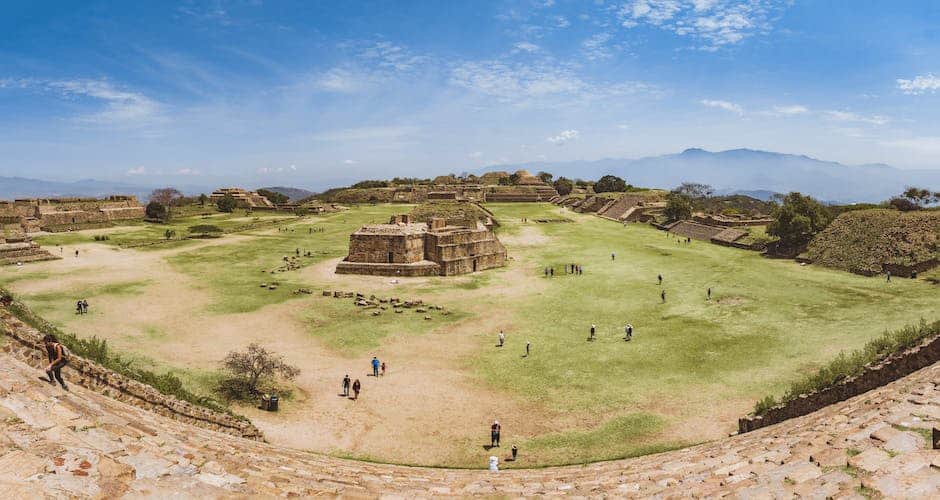
The Zapotec Ruins of Monte Albán is a UNESCO World Heritage site located in the southern Mexican state of Oaxaca. This ancient city was once the capital of the Zapotec civilization and flourished from about 500 BC until around 800 AD.
Today, visitors can explore the ruins of Monte Albán and discover the fascinating history and mysteries of this pre-Columbian civilization. The site is located on a mountaintop and offers breathtaking views of the surrounding valley and city of Oaxaca.
The architecture of Monte Albán is awe-inspiring, with its intricate design and construction that reflect the importance of the site as a religious and cultural center of the Zapotec civilization. Visitors can see the impressive buildings, including temples, courts, and palaces that showcase the advanced engineering and construction techniques of the time.
In addition to the architecture, the site is home to an array of art and artifacts that offer insight into the daily lives, religion, and cultural practices of the Zapotec people. From the ornate carvings on the stone monuments to the delicate ceramic figurines, visitors can appreciate the artistic achievements of this ancient civilization.
Monte Albán is also significant for its astronomical observatory. This feature highlights the advanced knowledge the Zapotec civilization had of astronomy and their ability to observe and record celestial events.
Today, Monte Albán is not only an important historical site but also an ongoing archaeological project that uncovers new discoveries and insights about the Zapotec civilization. It is a must-visit destination for anyone interested in history, culture or archaeology.
Step into the Past: Exploring the Impressive Architecture of Monte Albán
The Zapotec ruins of Monte Albán represent one of the most fascinating ancient cities in Mexico and are one of the country’s most prized World Heritage Sites. Located within the state of Oaxaca, Monte Albán boasts an incredibly rich history, fascinating architecture, and breathtaking views of the surrounding valleys.
Despite having been constructed more than 2,500 years ago, the structures remain surprisingly well-preserved and offer insight into the ingenuity of the Zapotec civilization. The complex structures of Monte Albán reveal sophisticated urban planning and architectural techniques that were ahead of their time. The city features over 170 artificial terraces, grand plazas, monumental buildings, altars, and tombs, all of which were constructed in harmony with the natural landscape and the position of the sun and stars in the sky.
What is particularly striking about Monte Albán is the impressive pyramid-shaped building at the center of the complex called the Great Plaza. This structure, known as Building J, is one of the oldest and most unusual buildings on the site and has been the subject of much speculation and mystery. Complex sculpted designs on the walls adorn the structure, adding to its mystique.
The complex layout of the city is believed to have had more than just practical applications. The layout and orientation of the city have been thought to have significant spiritual and cosmological importance to the Zapotec people. The designs of the buildings and their purpose have yet to be fully understood, adding to the allure of the complex.
Visitors to Monte Albán today can follow the same paths and climb the same steps that the Zapotec people did thousands of years ago. Standing atop one of the many buildings in the city, visitors can experience stunning panoramic views of the surrounding valley and marvel at the engineering skills and creativity of the Zapotec civilization.
Discovering the Secrets of the Zapotec Civilization through Monte Albán’s Art and Artifacts
The ancient city of Monte Albán, located atop a hill in the southern Mexican state of Oaxaca, is a treasure trove of art and artifacts that offer a glimpse into the lives and beliefs of the people who once lived there. The Zapotec civilization, who inhabited the area from around 500 BCE until the arrival of the Spanish in the 16th century, left behind a rich legacy of art and culture that is still being studied and explored to this day.
Among the most fascinating pieces of art found at Monte Albán are stone carvings and sculptures that depict human figures, animals, and symbols of the Zapotec’s complex religion. Many of these artifacts were discovered in the city’s numerous tombs, which were used to bury the region’s elite and important religious figures. While the meanings of many of the symbols and images depicted in the art are not fully understood, scholars continue to study and analyze the artwork to gain a greater understanding of this enigmatic civilization.
Another important area of exploration at Monte Albán is the city’s extensive system of aqueducts, which were used to bring water to the various neighborhoods and buildings throughout the city. The engineering required to create and maintain such a system was highly advanced for the time, and studying the aqueducts gives us insight into how the Zapotec people supported a large and complex urban society in an arid region.
In addition to providing a window into the past, the art and artifacts of Monte Albán also shed light on contemporary Mexican culture and modern-day interpretations of the Zapotec civilization. For example, many of the images of gods and goddesses found in the art have been absorbed into the religious practices of the modern-day Oaxacan people, who continue to draw inspiration from their pre-colonial past.
Overall, the art and artifacts of Monte Albán provide a fascinating glimpse into one of the most important civilizations of ancient Mexico. Through careful study and analysis of these treasures, we can continue to learn more about this enigmatic culture and gain a greater appreciation for the rich diversity of the pre-Columbian world.
The History and Mysteries behind the Zapotec Ruins of Monte Albán
The ancient Zapotec ruins of Monte Albán in Oaxaca, Mexico, date back to 500 BCE, making it one of the oldest Mesoamerican archaeological sites in the region. The name, Monte Albán, means “White Mountain” in Spanish, and it sits atop a flattened mountaintop at an altitude of approximately 6,400 feet. The site was initially founded as a religious center, and it later became the capital city of the Zapotec civilization for centuries.
The Zapotecs were one of the most advanced civilizations in Mesoamerica, known for their astronomical knowledge, sophisticated writing system, complex calendar, and innovative architecture. Monte Albán was a hub of religious, political, and economic activities in the region, serving as a meeting point for various other nearby civilizations.
Much of the city’s history remains shrouded in mystery since the Zapotec people did not leave texts explaining their civilization. However, the ruins offer a glimpse into the ancient Zapotec world through its fascinating architecture, art, and artifacts.
One of Monte Albán’s most remarkable features is its impressive architecture. The Zapotecs extensively modified the mountain’s slopes to create terraces and leveled monumental platforms that served as foundations for their buildings. The site offers an extensive network of plazas, palaces, temples, ball courts, and tombs of various shapes and sizes that attest to the empire’s complexity.
Another significant aspect of the Monte Albán ruins is the tombs that were discovered in the mid-twentieth century. The tombs provide valuable information about the Zapotecs’ culture and religion, as well as their practices concerning death, burial, and the afterlife. Specifically, Tomb 7 is notable for the wealth of artifacts, including pottery, masks, jewelry, and carved stones, found inside.
The Zapotec people were also skilled artists, and their art serves as a crucial link to understanding their culture. The site offers various examples of Zapotec art, including hieroglyphs, figurines, stelae, and murals. These works of art depict a diverse array of subjects, ranging from religious rituals and mythological creatures to everyday life scenes.
Given its location and construction, Monte Albán was undoubtedly built with an astronomical purpose in mind. Indeed, the site’s main acropolis served as an observatory, where priests observed the stars’ movements to predict the seasons and important celestial events such as solstices and equinoxes. Additionally, the site’s layout and orientation to the cardinal points show the Zapotecs’ deep understanding of astronomy and architecture.
Monte Albán’s mysteries continue to attract scholars, archaeologists, and visitors from all over the world. Its impressive ruins offer a glimpse into the fascinating history and culture of one of Mesoamerica’s most advanced civilizations, and they continue to inspire discoveries and insights into our shared human past.
Understanding the Importance of Monte Albán’s Astronomical Observatory
Monte Albán, the ancient Zapotec city located on a mountaintop in the Oaxaca Valley of Mexico, is known for its extensive ruins that reflect the magnificence of the Zapotec civilization. Among several impressive structures, there is one that stands out – the astronomical observatory. This structure, though not as visually striking as the others, played an essential role in the life of the Zapotecs, primarily due to their beliefs in astronomy and the importance they placed on celestial events.
The observatory is a small, square building with a single opening. It features a precise alignment to a distant mountain peak, making it an essential instrument for observing astronomical events such as solstices, equinoxes, eclipses, and the transit of celestial bodies. The Zapotecs utilized the observatory to keep track of the passage of time, to calculate the length of the year, and to monitor the seasons, which was essential for sowing and harvesting crops.
One of the most impressive aspects of the observatory at Monte Albán is that it predates other well-known observatories, such as the one at Chichen Itza in the Yucatan Peninsula of Mexico, by nearly 500 years. This suggests that the Zapotecs were not only advanced in architecture and engineering but also in astronomy, placing them among the most scientifically advanced civilizations of ancient Mesoamerica.
However, the observatory’s importance wasn’t limited to agriculture and astronomy. It was also linked to Zapotec religion, which placed great significance on astronomical events. Many of the Zapotec gods were associated with celestial bodies, and certain times of the year were marked by rituals and festivities coinciding with those events. Therefore, the knowledge gained from the observatory and astronomy helped in predicting celestial events, leading to an accurate interpretation of Zapotec religious beliefs and the celestial hierarchy of their gods.
Today, the importance of the observatory at Monte Albán extends beyond its historical and cultural significance. It is a testament to the Zapotecs’ remarkable scientific abilities and serves as an inspiration to modern-day astronomers and scientists studying Mesoamerican astronomy and related fields. The observatory remains an awe-inspiring place, a testament to one of the most sophisticated pre-Columbian civilizations in the world.
Revisiting Monte Albán: Contemporary Significance and Ongoing Preservation Efforts
Monte Albán, one of Mexico’s most significant archaeological sites, continues to be a source of intrigue and mystery to this day. The ancient city was founded by the Zapotec civilization in 500 BC and was a center of political, economic, and religious activities for centuries. Even though Monte Albán is now a UNESCO World Heritage site, it faces several contemporary issues and ongoing preservation efforts that require attention and action.
One of the most pressing issues that Monte Albán faces is the influx of tourists, which poses a threat to the site’s structural integrity and preservation. While the government has taken steps to regulate visitor access to certain areas and control the impact of tourism, there is still much work to be done.
Another challenge that Monte Albán faces is the natural degradation of its ancient structures and artifacts. The site was built primarily with stone and clay, which are susceptible to erosion and decay. The government has embarked on several restoration projects to preserve the site’s structures, but resources and efforts are limited.
Despite the challenges, Monte Albán remains a culturally significant site in Mexico and continues to evoke the curiosity of archaeologists, historians, and tourists alike. The site is crucial in understanding the history of the Zapotec civilization and their impact on Mesoamerican culture.
Contemporary efforts to preserve Monte Albán include the implementation of sustainable tourism practices that balance the site’s conservation and economic benefits. Additionally, archaeological research continues to uncover new information about the site’s ancient inhabitants and to preserve artifacts for future generations.
As visitors to Monte Albán, it is essential to be mindful of the site’s significance and the need for its protection. By respecting the site’s rules and regulations, we can all contribute to preserving this cultural treasure for future generations.
The Symbolism of Tomb 7: An Insight into Zapotec Religious Beliefs
Monte Albán, the ancient Zapotec city in the Valley of Oaxaca, is known for its impressive pyramids, structures, and plazas that date back to the Pre-Columbian era. However, one of the most significant discoveries in recent history was the uncovering of Tomb 7, located in the southern platform of the Great Plaza, by Mexican archaeologist Alfonso Caso in 1932.
The tomb was traced back to the Late Classic period (between 650 to 850 CE), and its significance lies in the myriad of sculptures, jewelry, and artifacts that were found inside, which provided a unique window into the religious beliefs and practices of the Zapotec civilization. Among the discovered treasures was the famous regalia of Lord Pakal, who was the ruler of Palenque, and ceramics reflecting Teotihuacan design.
The depiction of the female figurines lining the walls of the tomb reflects the importance of women in the Zapotec religion, who believed in a complex spiritual pantheon that included fertility goddesses, rain gods, and animals. In addition to this, the priests depicted in the tomb were adorned with symbolic jewelry, such as the eccentric nose clips, that was used as a method of divination and to achieve a state of heightened consciousness during rituals.
The various artifacts and sculptures found in Tomb 7 not only provide vital information about the religious beliefs of the Zapotec civilization but also bring to light the artistic and cultural influences of neighboring societies such as the Teotihuacan civilization. This discovery has led to further research and exploration of other tombs and structures within the Monte Albán site that represent important facets of the Zapotec civilization.
The study of the offerings and regalia found within Tomb 7 has also allowed scholars to reconstruct a more comprehensive understanding of Zapotec cosmology, and how their beliefs intertwined with their architecture and artwork. Tomb 7 has been heralded as a critical discovery in the field of archaeology and has allowed us to learn about the lesser-known aspects of one of the most important Mesoamerican civilizations.
Conclusion
Visiting the Zapotec Ruins of Monte Albán is an unforgettable experience that takes exploring the history of the Mesoamerican civilization to the next level. From the impressive architecture to the secrets of the artwork, this archaeological site is a treasure trove of historical mystique that teaches us about the past and the heritage of the indigenous Zapotec people.
Monte Albán’s astronomical observatory is an impressive feat of Mesoamerican architecture, showcasing the Zapotec civilization’s keen interest in the night sky’s movements. Tomb 7’s intricate decoration provides an insight into Zapotec religious beliefs, adding a unique cultural dimension to this historical site. Preservation efforts continue to ensure Monte Albán remains a relevant reminder of the Mesoamerican heritage and is accessible to visitors interested in learning about this ancient civilization.
The Zapotec Ruins of Monte Albán are an attraction for all people interested in the ancient histories of the world, and it appeals to scholars researching the myths and legends surrounding the Zapotec people. The site teaches newcomers about the cultural importance of preserving the past, and how we need to acknowledge and recognize different perspectives to create a shared understanding of history.
Visitors come from around the world to explore Monte Albán’s outstanding cultural heritage, and they leave inspired by the history of the Zapotec civilization. We invite everyone to immerse themselves in this historical site, deeply rooted in the Mesoamerican past, to understand the importance and the impact of Monte Albán on contemporary society.


